
Installation
Wedge Anchor Embedment Depth and Edge Distance Explained
Three things cause almost every wedge anchor failure: a dirty hole, insufficient embedment, and being set too close to an edge. All three are avoidable at the drilling stage.
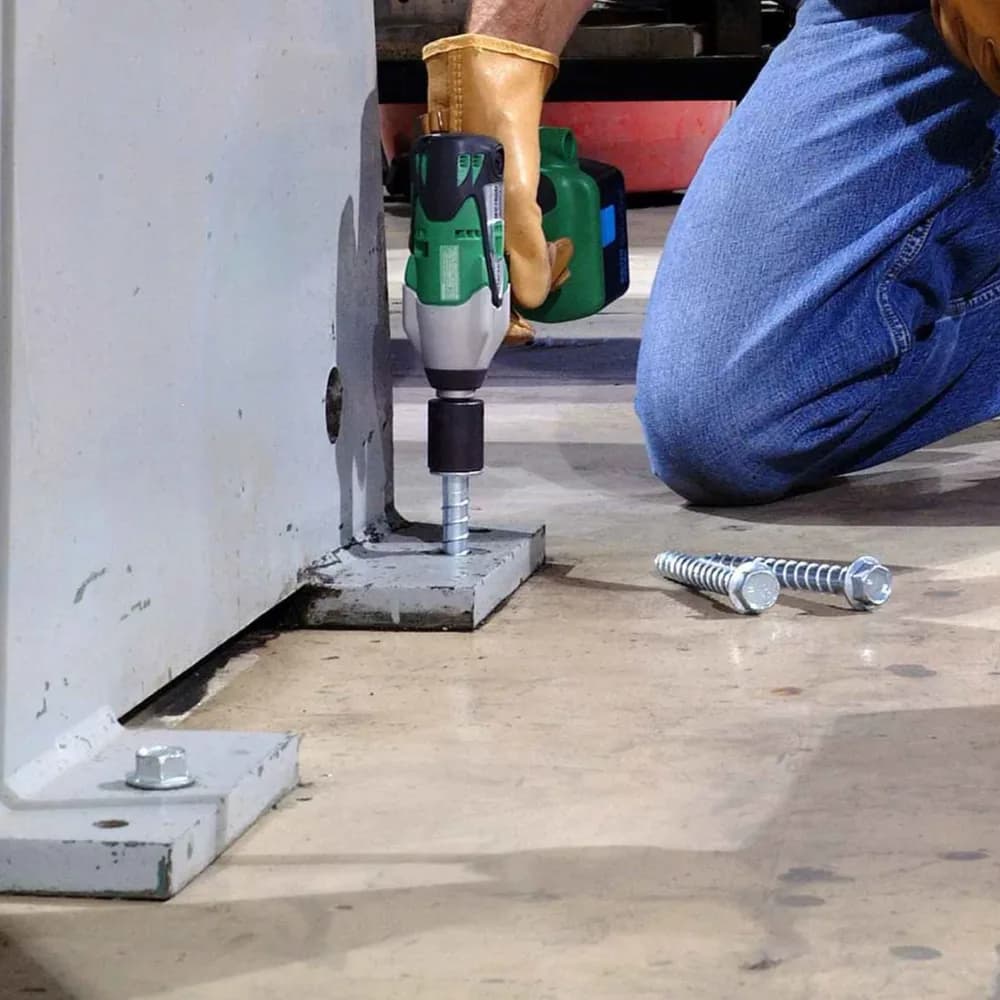
Getting wedge anchor embedment depth right is the difference between a fixing that carries its rated load and one that does not — and a wedge anchor that has been installed badly looks exactly like one that has been installed well. That is what makes anchor failures so expensive — nothing is visible until something moves.
Almost every failure we get asked about traces back to one of three things. None of them are difficult to avoid, and all three are decided before the nut is ever tightened.
The three rules
Wedge anchor embedment depth: 4.5 to 5 times the diameter
Wedge anchor embedment depth is measured from the concrete surface to the tip of the anchor — not the length of the anchor, which includes whatever is sticking out through the fixture.
| Anchor size | Minimum embedment | Minimum edge distance | Minimum spacing |
|---|---|---|---|
| M8 | 40 mm | 48 mm | 80 mm |
| M10 | 45–50 mm | 60 mm | 100 mm |
| M12 | 55–60 mm | 72 mm | 120 mm |
| M16 | 75–80 mm | 96 mm | 160 mm |
| M20 | 90–100 mm | 120 mm | 200 mm |
These are working minima for sound concrete of grade M20 or better. Deeper embedment increases capacity up to a point; shallower embedment reduces it disproportionately, because the cone of concrete resisting pull-out shrinks with the square of the depth.
Edge distance: 6 times the anchor diameter
A wedge anchor works by pushing outward. Set it too close to a free edge and that outward force has nothing to push against — it simply splits a wedge of concrete out of the slab.
Six diameters is the working minimum. An M12 anchor therefore wants at least 72 mm to any free edge, and that means the actual edge of the concrete, not the edge of the base plate sitting on it.
Spacing: 10 times the anchor diameter
Two anchors set close together share the same cone of concrete, so their combined capacity is far less than the sum of two isolated anchors. Ten diameters between centres keeps them independent.
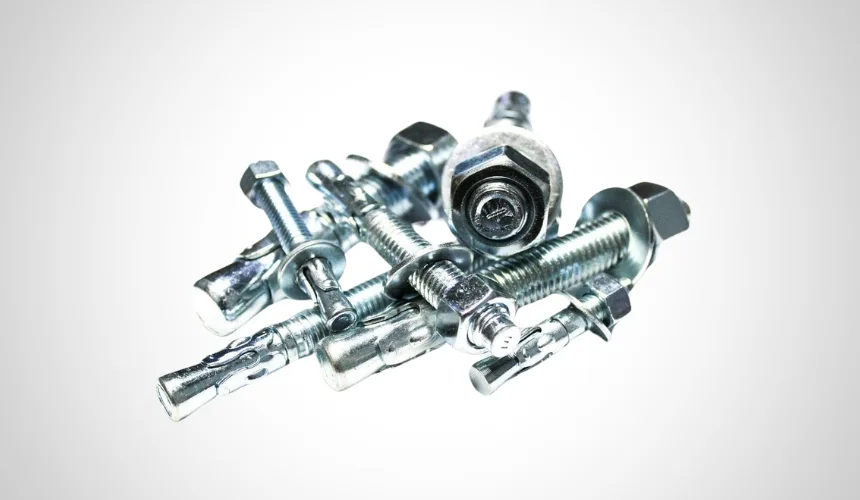
The hole is the anchor
More anchors fail because of a dirty hole than for any other single reason, and it is entirely preventable.
Drilling dust behaves like a lubricant between the expansion clip and the concrete. An anchor set in a dusty hole can pull out at a fraction of its rated load and give no warning at all — it will torque up perfectly.
The sequence that works:
- Drill 15 mm deeper than the anchor will sit. Debris has to go somewhere, and it collects at the bottom.
- Blow the hole out with compressed air or a blow pump.
- Brush it with a wire hole brush sized to the hole.
- Blow it again. This second blow is the one people skip, and it is the one that removes what the brush loosened.
Overhead holes need more attention, not less, because gravity is working against you the whole time.
General fastener requirements in India are covered by IS 1367, and stainless anchor grades by ISO 3506.
Torque, and why it matters
Tightening a wedge anchor is not the same as tightening a bolt. The torque is what draws the cone into the expansion clip and sets the anchor. Under-torque and it is not set; over-torque and you can spall the concrete or strip the thread.
| Size | Setting torque |
|---|---|
| M8 | ~25 Nm |
| M10 | ~45 Nm |
| M12 | ~60 Nm |
| M16 | ~110 Nm |
| M20 | ~180 Nm |
Use a torque wrench. Judgement by feel varies enormously between operators, and on a base plate with eight anchors, uneven setting means the load is not distributed the way the design assumed.
When a wedge anchor is the wrong choice
Wedge anchors are excellent in solid concrete under mainly tensile load. They are not the right answer everywhere.
Hollow block, AAC, perforated brick — use a nylon frame fixing, which distributes force along a sleeve instead of relying on point expansion.
Old or low-grade concrete, or heavy shear and vibration — a rawl bolt spreads expansion over a full-length sleeve, which puts far less peak stress on the concrete and holds much better under lateral and dynamic load.
Anything that has to be removable, or overhead services — a drop-in anchor sets flush and leaves an internal thread, so the fixture comes off and goes back on without disturbing the anchor.
Light, high-volume fixing — pin type anchors set with a hammer in seconds.
Quick answers
Can I re-use a wedge anchor? No. The expansion clip deforms permanently. Cut or drive the old one below the surface, make good, and set a fresh anchor at proper spacing.
What drill bit size? Exactly the nominal anchor diameter. An M12 anchor takes a 12 mm carbide bit. This surprises people — most fixings need an oversize hole, but a wedge anchor is designed to pass through a hole its own size.
How much load will it take? It depends on diameter, embedment, concrete grade and edge distance, so no single figure is meaningful. We can supply the manufacturer's performance data for whichever size you are specifying — ask, and apply the appropriate safety factor against your actual load case.
How do I check embedment depth after installation? You cannot, directly — which is why it has to be confirmed at the drilling stage. Mark the drill bit with tape at the required depth and check every hole before the anchor goes in.
Does the anchor need to be flush with the fixture? The washer should be firmly against the fixture with two or three threads showing past the nut. If more of the anchor is proud than that, it is probably not embedded deeply enough.
Before you sign a fixing off
- Wedge anchor embedment depth confirmed at 4.5–5 diameters
- Edge distance confirmed at 6 diameters or more
- Hole blown, brushed, blown again
- Torqued with a wrench to the stated figure
- Washer seated, two to three threads showing
Our full anchors and rivets range covers M6 to M24 in zinc, hot-dip galvanised and stainless. Send us the load case and the substrate and we will specify it properly rather than by eye.
Need this specified for a live job?
Send us the substrate, the load and the environment and we will confirm the right size and grade — usually the same working day.